Government confirms three new unitary councils for Oxfordshire and West Berkshire in 2028
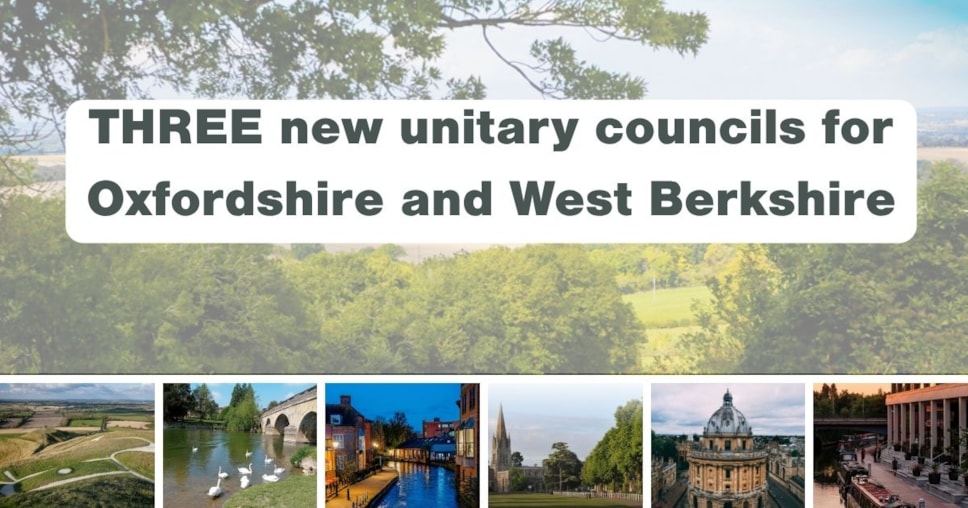
The government has today (16 July) announced that Oxfordshire and West Berkshire’s seven existing councils will be replaced by three unitary councils from 1 April 2028 as part of its plans for local government reorganisation (LGR).
The new councils will be:
- Greater Oxford Council – covering Oxford and its immediate surroundings.
- Northern Oxfordshire Council – covering most of the existing Cherwell and West Oxfordshire districts.
- Ridgeway Council – covering most of the existing South Oxfordshire and Vale of White Horse districts, combined with West Berkshire.
The change will mean one council is responsible for local services – such as housing, planning, recycling, roads and social care – in each area, rather than responsibilities being split between county, city and district councils. Three proposals were presented to government in November 2025 by Oxfordshire and West Berkshire councils – a single county unitary, two unitary councils and three unitary councils.
These councils have been working together since the start of the year to plan for any decision the government may make. This work has been focused on ensuring services continue without disruption for residents, as well as on how they deliver the benefits that unitary councils offer.
Councillor Andy Graham, Leader for West Oxfordshire District Council, said:
“Today’s announcement by Government to proceed with a three-unitary model for Oxfordshire is deeply disappointing.
“West Oxfordshire has consistently supported a two-unitary solution because we believe it offered the strongest foundation for the future of local government across Oxfordshire. It would have created simpler structures, reduced duplication, strengthened financial resilience and, most importantly, delivered better outcomes for residents and communities.
“We respect that the Government has reached a different conclusion. However, we remain unconvinced that a three-unitary model will provide the simplicity, efficiency and long-term financial sustainability that ministers said they wanted to achieve.
“At a time when councils face unprecedented financial pressures, creating three separate organisations means additional costs that could otherwise be directed towards protecting frontline services. Local government reorganisation should simplify the system, not create further complexity.
“Throughout this process, West Oxfordshire has worked constructively and in good faith with Government and our partner councils. We have sought to develop proposals that reflected the evidence, met the Government’s own criteria and, above all, put residents first. While we are disappointed by today’s decision, we remain committed to working constructively with all partners to ensure the transition is managed responsibly and effectively.
“For West Oxfordshire, our priority has always been clear: ensuring that residents continue to receive high-quality local services while protecting the distinct identity of our towns, villages and rural communities. Those communities deserve councils that understand their needs, respond to local priorities and remain accountable to the people they serve.
“This decision does not change our commitment to the people of West Oxfordshire. We will continue to deliver the services residents rely upon, invest in our communities, support economic growth, tackle the housing and climate challenges we face and provide strong local leadership during what will undoubtedly be a significant period of change.
“The Government has made its decision. Our responsibility now is to ensure that West Oxfordshire’s voice continues to be heard, that our communities remain at the heart of the discussion, and that any new arrangements are shaped by the needs of residents.
“Together with our partners and communities, we will continue to stand up for West Oxfordshire, work constructively through this transition and do everything possible to secure the best future for the people we are proud to serve.”
The government ran a statutory consultation in February 2026 on the options with local stakeholders, residents and businesses invited to have their say. The results of the consultation have been published today on the government’s website.
Over the next two years, the existing councils will continue working together to prepare for the new arrangements, keeping people informed as plans develop ahead of April 2028.
The details of the three-unitary proposal can be found on 3councils.org
Contact Information
West Oxfordshire District Council Communications Team
Notes to editors
The government has set out guidance on how the transition should progress. This information can be found at: https://www.gov.uk/government/publications/local-government-reorganisation-implementation-guidance
Key timeline
- Proposals submitted: 27 November 2025
- Public consultation: 5 February 2026 - 26 March 2026
- Government’s minded-to decision: 16 July 2026
The minded to decision is the government’s preferred, provisional decision before it’s put into law through a structural changes order (SCO).
- Structural changes order (SCO): Expected Autumn 2026.
An SCO is legislation that will officially end the existing two-tier county and district councils in Oxfordshire. We expect the legislation to be laid and agreed at this point, but it won’t come fully into effect until vesting day.
- Elections: May 2027.
After the elections shadow authorities will be created to plan the new councils, but they will not deliver services. It will focus on preparing for the future council.
- Transition period: Expected late 2026 - March 2028.
- Vesting day: New council begins 1 April 2028.
The official go-live date when the new council takes over and legal powers, responsibilities and ownership transfers from the previous councils to the new one.